
Modular Liquid Cooling AI DC: 90 Days EXW + L1240/L1800
When AI densification forces Liquid Cooling onto the pad, two procurement questions arrive at once. Which standard block fits the site you actually have? And what does “ninety days” mean when a vendor says it?
This page is the late-funnel answer for both. MDCX sells a Liquid Cooling envelope — space, cooling, and power — as a factory-built product. You bring the silicon. The dual-primary Aliases are L1240C45 and L1800C45. The honest factory clock is 90 days ex-works from down payment — not a summed dirt-to-online promise. For the deeper factory-tested versus field-built contrast, see the sibling post Factory-tested vs field-built modular AI data centers. Industry context often cites conventional stick-built halls in the 18–36 month range — that is schedule pressure context, not an MDCX delivery claim and not a named-competitor dunk.

A factory-built Liquid Cooling envelope — space, cooling, and power in a 45 ft High Cube. You bring the silicon.
Modular Liquid Cooling for AI is a product, not a room
AI racks climb into densification that air-cooled rooms were never designed to hold. The useful response is not another custom hall. It is a standard Liquid Cooling block you order as a product: a prefabricated, factory-tested container that already integrates the envelope systems you would otherwise discover on site.
That vocabulary matters. MDCX does not sell GPUs. The customer brings the servers. The envelope stays GPU-agnostic so silicon roadmaps can move without forcing a new facility architecture every generation. Methodology and Speed as a product attribute live on Why MDCX. Line-level Liquid Cooling options sit on the Liquid Cooling hub.
Pick the Alias from pad power reality
Both dual-primary blocks share a 45 ft High Cube footprint. The fork is pad power — not marketing preference.
| Pad condition | Alias | SKU | What changes |
|---|---|---|---|
| Empty pad — nothing on site yet | L1240C45 | L1240C45SUR150 | UPS + battery inside the box; lead empty-pad buy |
| Out of floor, not out of power | L1800C45 | L1800C45DR220 | UPS outside; more IT in the same 45 ft shell |
L1240C45: empty pad, UPS inside
L1240C45 is the empty-pad Liquid Cooling block: 1,240 kW IT, up to 150 kW/rack (R150), single warm-water loop, with UPS and battery integrated in the container. On site you connect utility, water, and network — not a second power-distribution project inside the box.
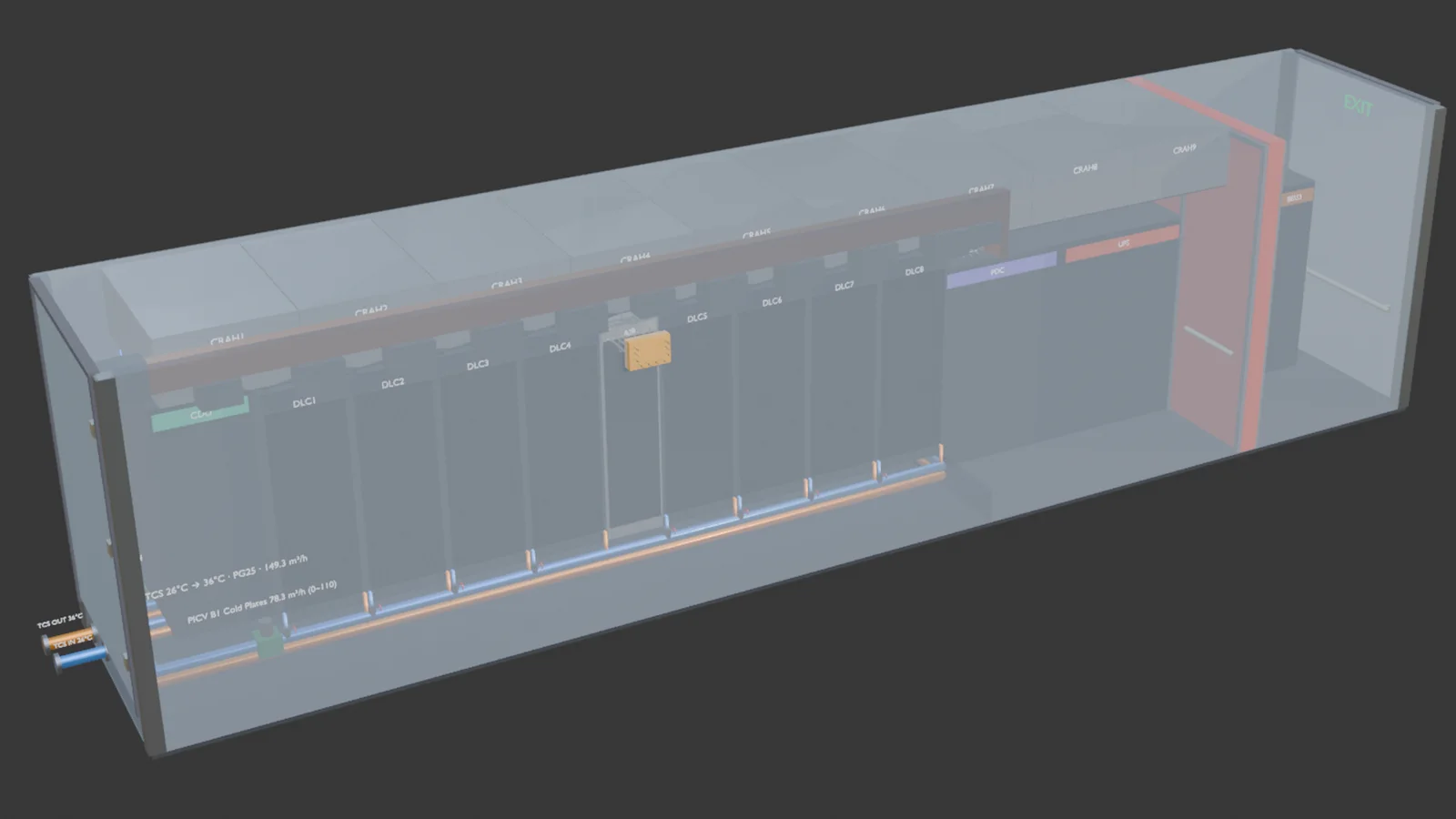
L1240C45 — empty-pad lead. UPS and battery sit inside the 45 ft box.
L1800C45: UPS outside, more IT in the same footprint
L1800C45 is the density ceiling of the Liquid Cooling line in that same 45 ft High Cube: 1,800 kW IT, up to 220 kW/rack (R220), dual loop, with UPS left outside because the pad already paid for distribution. Omitting UPS is intentional — the site should not buy power twice.
Decision rule: no yard power plant yet → L1240C45. UPS / PDC already on the pad → L1800C45.
Immersion aside (secondary only): PCIe fleets may prefer Immersion Cooling rather than cold-plate Liquid. That is a form-factor fork, not the empty-pad lead story on this page.
What “90 days EXW” actually means
Operators mid-RFP usually need a sentence they can defend in a schedule workshop. Here it is: the MDCX factory clock starts when down payment clears, and it ends when the block is ready ex-works — at the factory gate — not when the first rack is earning on your pad.
90 days ex-works is the MDCX factory clock for first and expansion Liquid Cooling blocks, counted from down payment. Ex-works means the block is ready at the factory gate. It is not a door-to-door or dirt-to-compute-ready guarantee.
- When the production line is full, the first block may take up to 120 days. Expansion blocks remain on the 90-day EXW quote.
- Freight and customs are buyer-arranged. MDCX does not invent those days into the factory clock.
- Grid interconnection stays a separate critical path outside MDCX delivery.
SERP copy often collapses logistics, utility work, and factory build into one “operational in N days” number. That habit is convenient and dishonest. Procurement needs a clock it can put in a contract without inventing someone else’s freight.
Four delivery segments — quoted alone, never summed
MDCX publishes four segments as typical bands. They are quoted alone. They are never summed into one fake end-to-end timeline.
| Segment | Typical band | Owner note |
|---|---|---|
| Survey & solution | 3–4 wk | Site / grid interface; lock a standard configuration |
| Manufacture | 12–15 wk | Prefabricated integration + factory test before ship |
| Shipping | ~7 wk typical | Freight & customs: buyer-arranged |
| Install & power-on | 3–4 wk | Crane lift, quick-connect, commissioning of the block |
Adding those bands into “X weeks total” invents a critical path MDCX does not sell. Keep the factory clock at EXW. Keep logistics with the buyer. Keep interconnection on its own rail.
Factory-tested Liquid Cooling container (no percentage theater)
“Factory-tested” here means the Liquid Cooling envelope — heat rejection, power topology, and controls — is proven as plant behavior before the container leaves the line. Prefabricated integration retires discovery risk in the factory instead of on your pad.
That is the operator difference that survives an RFP review. Field-built rooms still invent plant behavior during mechanical finish. A factory-tested Liquid Cooling container arrives as the unit that already ran as a plant — so pad work is installation and quick-connect, not first-time system discovery in the weather.
This page deliberately uses prefabricated / factory-tested language without a prefabrication percentage. Percentage theater is easy to inflate and hard to audit. The sibling post covers the factory-tested versus field-built contrast in depth; this URL owns Alias choice and EXW honesty.

A factory-tested envelope is commissioned as plant before it ships — heat rejection, power, and controls on the same unit that lands on the pad.
CIOS on the site plane (short)
Every MDCX block includes CIOS — the Compute Infrastructure Operating System — on the site plane today: path-addressed telemetry, Modbus TCP and SNMP v2c drivers, alarms that become tickets, and usage facts for operational truth. CIOS does not invoice. Open-core Apache-2.0.
Roadmap only — not shipped: multi-site fleet plane, GPU-level telemetry, AI Ops, and Omniverse. Those stay fenced so a site OS that ships is never confused with a future fleet story. Deep CIOS product detail belongs on /cios, not here.
CapEx starting point and next step
Published starting CapEx is $3M/MW of IT power — indicative, not a quote. That figure is a published starting point for modeling, not an invoice and not a competitor-price comparison. Model utilization, power, and payback in the interactive TCO tool before you treat any CapEx line as commercial truth.
Skip bare PUE marketing on this page. Liquid Cooling operating points are climate-dependent; if you need an efficiency figure, confirm it in TCO / Designer rather than treating a mid-climate band as an unconditional product rating. Keep IT load and facility load separate in every spreadsheet — 1,240 kW or 1,800 kW on the Alias is IT capacity, not total facility draw.
Secondary: TCO · L1240C45 · L1800C45 · CIOS · Factory-tested vs field-built
FAQ
What does 90 days EXW mean for an MDCX modular Liquid Cooling AI data center?
First and expansion MDCX Liquid Cooling blocks are quoted at 90 days ex-works from down payment. That factory clock does not include freight or customs, which are buyer-arranged. When the production line is full, the first block may take up to 120 days; expansion blocks remain on the 90-day EXW quote. Delivery is quoted as four segments alone — survey, manufacture, shipping, and install — and those segments are never summed into one fake end-to-end timeline. Grid interconnection stays a separate critical path.
How do I choose between L1240C45 and L1800C45?
Choose from pad power reality. L1240C45 is the empty-pad lead: UPS and battery sit inside the box. L1800C45 fits when the pad already has power distribution: UPS sits outside, so the same 45 ft High Cube footprint carries more IT. Both are Liquid Cooling envelopes — space, cooling, and power — and the customer brings the silicon. Product detail: L1240C45 and L1800C45.
What ships in the container, and what does CIOS cover today?
MDCX ships a prefabricated, factory-tested Liquid Cooling envelope, not GPUs. Every block includes CIOS on the site plane today (site telemetry, ticket path, usage facts; CIOS does not invoice). Multi-site fleet operations, GPU-level telemetry, AI Ops, and Omniverse remain Roadmap. Starting CapEx is published from $3M/MW and should be modeled in the TCO tool — indicative, not a quote.